Showing posts with label diabetes. Show all posts

Friday, December 12, 2008

Insurance coverage: advocating for CGMS in a system that leaves many people out

Today I received an email from JDRF about their campaign to get continuous glucose monitoring (CGMS) covered by insurance companies. I want my insurance to cover CGMS so that I could use it. I don't think they have any business denying people coverage to this device that is helpful to our health and probably lifesaving for people with hypoglycemia unawareness. But I also don't think health insurance companies or our health care system in general as any business denying anyone coverage. It pisssed me off that this is JDRFs focus when there are more pressing issues for many people.

I wrote back:

I want CGM covered, but MUCH MUCH more than that, I want a single payer health care system that covers everyone in this country.

Please fight for things that will help ALL diabetics and that are much more necessary than CGM. I test 10 times a day, and sometimes wish I had CGM (for example, tonight, I am up late because I worry that my blood sugar is dropping). The diabetics that come to the free clinic I volunteer at are all uninsured, and cannot afford test strips. If they come to the clinic, wait on the waiting list for the diabetes education class, and then attend all the classes, they receive enough strips to test once a day. Though they are type 2s, this includes many people on insulin. People taking insulin that can test their blood sugar once or less a day. As for yearly dilated exams (more often if retinopathy is already present)? The waiting time to see an opthalmologist is 22 months

The millions of diabetics that are uninsured or underinsured and can't even access the basic necessities of diabetes care deserve much more help and I think it's abominable that this is your priority.

Sincerely,
me


We need healthcare for EVERYONE that leaves nobody out. We need a universal single-payer system (expanded & improved Medicare for all) now.

Wednesday, September 03, 2008

Thinking back to the aftermath of Hurricane Katrina

Hurricane Gustav and the anniversary of the destruction and criminal neglect of the people in New Orleans after Hurricane Katrina had me thinking back. Katrina hit before I left home in Chicago to go back to school for the year, and the aftermath continued as I settled in on campus. One of my professors remarked that people "feel like the world is ending" with all of the recent events - Katrina, the tsunami in late 2004, even going back to September 11th.

I didn't share that sense of terror or a strong connection to events like the tsunami or September 11th (especially not September 11th, which did not seem any more tragic to me than the tens of thousands of people that die every year in the U.S. from lack of access to healthcare and other forms of violence the media is not interested in). Yes, sadness that so many were dying, frustration and disgust with the responses of people and structures that could have helped prevent tragedies of such scale or responded better, and dizziness from just trying to understand the sheer numbers of deaths, which my brain couldn't even compute. But not a sense of terror or grief that shook me to the core.

Katrina was different.

I was watching TV with my mom, and suddenly I found myself sobbing. The camera had just showed a young black woman crying and screaming that she was diabetic and she needed insulin and that she was going to die if they didn't get some insulin to her. It just got me - I reacted before I had even thought about it. It made me so upset and scared and incredulous and disgusted. It was just so wrong and so upsetting, and I did not understand how anyone or any structure could do that (deprive someone who is insulin dependent of their insulin) to another person.

Once I thought about it, I got enraged at everyone, the government especially but even all the way down to the news crew. If they had those resources (electricity and transportation and contacts and enough expensive equipment to get on national TV), how could they stand there fucking taping her screaming for her insulin and not get her some? This was not the first day after the hurricane hit either, I think it was at least day 3.

But what got me on such an immediate, visceral level was clearly the type 1 diabetes. And probably some element of seeing myself in that woman. Although I know on a rational level that my chances of being in that situation, as a wealthy white person with connections (in healthcare), are almost non-existant, it struck me. Maybe poked past some of the filters that structural racism has taught me to look through and the mainstream media perpetuates? Or perhaps I shouldn't have been surprised, I don't usually watch a lot of TV and so don't see all of the gruesome visuals on some disasters.

It also seemed much more urgent and close and part of my life because it was closer and happening in my country, a system that I am more directly part of. It was crude injustice: racism, classism and poverty laid out in such a raw, visible way. Ignoring or moving at a snail's pace to help people that are dying, in a way that just showed how little regard most of the people in power had for their lives. That stuff exists here all the time, but it was magnified and made more visible by the hurricane.

Thursday, July 10, 2008

Inventions I could actually use...

There is this gadget I have had in my head for a few months now. I swear, it seems simple enough, and important enough, that someone should be able to create it (or should have already). They're working on continous glucose monitoring sensors, even islet cell transplants. But what about just figuring out if my bottle of insulin, right now, is still good?

I want a little device that I can inject a few units of insulin into that will tell me if it is still good or not. One that could've helped me out last weekend, when I had no idea why I was 389 after dinner. Did I really do that bad of a job counting the carbs I ate? Or was that afternoon on the beautiful Lake Michigan beach too much for my vial of insulin without an icepack, even though I was careful to keep it covered up and in the shade?

A device that could've helped narrow down the cause of several spates of ridiculous and unpredictable blood sugars I've had over the past year or two, during which I was getting my insulin from a mail order pharmacy (way cheaper) that didn't seem completely trustworthy. Like when the insulin showed up during our late-summer heatwave last September and the ice was all melted. And when I called the company pharmacist to ask, he said, "Well, it took 5 days after it left our warehouse to arrive at your post office. We aren't responsible for what happens when our shipper has it." (WTF?! I'm paying you for my insulin and you can't be responsible for whether or not it gets to me in working condition?)

Anyways, someone needs to create this little gadget. It should be totally doable... the heat just denatures (unravels) the insulin proteins, right? So something that could detect the shape/structure of the insulin could figure it out?

I want inventions and technological advances that can actually help me control my blood sugars, and make doing so less stressful, and more convenient.

I want to know if my insulin is working or not, and not have my own body be the experimental test tube taking the hit to figure it out.

I want an infusion set that delivers insulin in a way my body can absorb (as it seemed I couldn't absorb well from all the infusion sets I tried in the last round of extreme blood sugar unpredictability and highs). I don't care if my insulin pump looks like a Minimed, an OmniPod, or an iPod, as companies and some diabetics are concerned about, judging by consumer surveys I did and blogger design contests. I just want it to work.


P.S. Thanks to everyone who commented on the last post (a gajillion years ago). It was nice to hear your thoughts and experiences and have a little discussion/support/camaraderie.

Tuesday, January 08, 2008

Before and After.

Ok, so this is what I meant to post about when I wrote the last one.

So maybe it sucks that this kid's body is getting displayed everywhere, but here's a before and after picture, courtesy of the awesome "Broken & Fabulous" zine. It's a type 1 diabetic kid in the 1920's, before and after insulin was discovered (and she was one of the lucky ones to get access to it in time). I'm sure some of you fellow diabetics have seen it before:
The above is just one of many reasons I don't respond well to pictures like this:
or this:

or people telling me how I look great after I've lost some weight (which this time, is largely due to high blood sugars, since I have definitely been exercising less and eating either similarly or more food and less healthy foods). So it is definitely not from being "healthier" this time, it's from being less healthy.

I have several issues with the prevalent "weight loss is always positive" idea, but this is just a part of why it's more complicated (medically/physically and emotionally/psychologically), and what it means to disappear or not disappear part of your body, what starvation means, etc. to me.

407 at 3:29

So despite promising myself earlier today (and yesterday, and last week) that I need to get on a better schedule, I'm up posting this at 3:29 am. Last night I actually had a dream which involved getting to work late, people stealing my desk (which actually does happen a lot, but this was more severe), and then realizing I was in some pretty awkward pajamas and not work clothes. And then I woke up, waaay after my alarm had started going off.

I actually did turn off my computer earlier (before 1) tonight in an effort to get to bed at a semi-reasonable hour, but I turned it back on because I was really frustrated with blood sugar issues, so I wanted to settle down (and break me off a little piece of that diabetes OC to help) before I try to go to sleep. Basically: after working out tonight, I'm 97. I don't eat anything, I go grocery shopping (which usually drops me), and 3 hours later, I'm 397. Wash hands, repeat: 382. Yup. My site doesn't hurt, no visible blood or loose tape, and isn't due to be changed until tomorrow afternoon (I try to change it every 2 1/2 days or less). When I took it out, there was blood in the cannula - but I had no way of knowing the site was bad until my blood sugars went nuts (and for a second, I felt guilty for not having tested for 3 hours, and then I realized that is ridiculous). I gave myself a shot, fairly aggressive but not super aggressive because it's near bedtime, and 2 hours later I haven't budged - I'm 407. Don't want to give myself a lot more insulin since it's still bedtime and sometimes my body reacts really late to insulin and I bottom out, but probably I need more before I go to sleep.

I know sites fail occasionally, but I just am frustrated and worried cuz it's happening all the time, again (this happened to me last winter/spring, I took a pumping break and tried some new sites). It seems like my pump isn't dependable anymore again. Or I don't even know. I have been in the 300s routinely in the last few weeks, despite not being sick, testing 12+ times a day, and not drinking much at holiday festivities. I started paying less attention because I was exhausted/burned out from paying so much attention and having things still not work out. Sometimes I am eating crappy or underbolusing or needing an adjustment in my insulin rates because I've been exercising less, but I don't even know how to sort out what's what, changes I need to make or bad sites any more. Between not trusting my pump and being burned out, I sometimes can't figure it out or just don't have the energy to. You know it's bad when you're going through ketone strips like crazy just to try to figure out if your pump is working... (hey, at least walgreens started making the generic ones now!)

Tuesday, November 20, 2007

I'm it! Here are my seven.

Jonah and Beth both tagged me for the seven random/weird things meme. Thanks! This is good, my exam today is done and I wanna get back to blogging. I feel like I already write here some of the weird things about me, but I'll try to cook up a few more.
  1. When I was little, I used to shave every morning. I would get really really jealous of my dad shaving, so he'd give me a plastic spoon and some shaving cream (the kind with an orange top that comes out as awesome turquoise gel and turns into creamy white foam when you rub it). I would stand next to him in the bathroom mirror and shave my face almost every day (except when I got out of bed too late, which yes, I was doing even at 5 or 6 years old). Kind of funny for someone who doesn't shave her legs or pits at all now. Or... maybe it makes perfect sense.
  2. I love thunderstorms.
  3. Sometimes when I have a really intense yawn or nose-blowing, I feel like I can breathe in air through my ears.
  4. I am kind of in love the idea of my body being pregnant. Not with the idea of having a kid, I really want nothing to do with having any kids right now (or possibly ever). Just the idea of my body being physically pregnant. This is the opposite of how most people feel I think - they want the kid without all the icky physical things about a pregnancy. And I am well aware of how ridiculous this may seem, especially considering the actual reality and the extra mental/emotional and physical burden that would come with a diabetic pregnancy. And I should know better, considering that what I do all day at work is review medical records of pregnancy, scary complications and all. And even scarier/more painful, labor and delivery records (can you say, episiotomy? how 'bout 2nd degree vaginal laceration? contractions at a pain level of 10 out of 10?). But that's why this is just a fantasy, and it's about the beauty and roundness and just the general physical idea of being pregnant.
  5. Speaking of being pregnant, people think I am all the time. I get people giving up seats for me on the train for no apparent reason except that they are looking at my belly and smiling sweetly at me/it. I get asked about it my strangers and less socially conscious/inhibited family members (most recently, my grandmother and a cashier in a cafeteria). I wrote about it a long time ago - I just have a belly on me, which isn't that proportional to the rest of me I guess. Haha, or maybe my thoughts from #4 cause me to give off some kind of vibe?
  6. My ring finger is my favorite for checking blood sugar.
  7. I eat apples from the bottom up instead of around the sides. Since I eat more of the apple than most people, usually a little tiny core, it's the best way to go at it.
I'm tagging bsom, estrogenmoment, Claire, misscripchick, Liz, Kameron, FatlyYours, Jes, and Hannah. (yes, that's 9... see below how I feel about rules! or above, how I feel about decisions...) I don't know if all of you do memes, but it's worth a try.

Rules (but I'm all about bending/breaking 'em if ya want):

1. Link to the person’s blog who tagged you.
2. Post these rules on your blog.
3. List seven random and/or weird facts about yourself.
4. Tag seven random people at the end of your post and include links to their blogs.
5. Let each person know that they have been tagged by posting a comment on their blog.

Friday, November 02, 2007

Call for submissions on wealth, redistribution, and class, and a few other things

1) I wanted to do "NaBloPoMo," or National Blog Posting Month. I'll admit the initial temptation was due to the great lolcats-themed badges. I am easy, anything related to that website wins me over immediately. But I do think it would be a great chance for me to learn to write shorter (and more frequent) posts, connect more with other diabetes bloggers doing it, and to force me to finish up all the half-written or outlined posts (there are lots) on stuff I've been wanting to write about, and generally get more comfortable writing and enjoy getting stuff out. However, I am really behind with the class I'm taking and at work, and kinda stressed, so I need to be looking for ways to limit, not increase, my internet time.

2) I went to my diabetes doctor this week - a few thoughts, I will write more later. There wasn't much in the way of surprises or even guilt because I know I've been struggling with my blood sugars a lot the last few months, and part of it is this weird absorption issue, among other things.

3) There's a new project that I heard about at Aid & Abet that looks great. It's a website called Enough, looking for submissions on wealth, redistribution, and class by November 15th-ish (loose deadline). I think it would be cool to get some stuff from you folks out there that involves health/illness, disability, and how that both affects and is affected by wealth, class, our economic system, and ideas for change, etc. I'm hoping to submit something.

One of the coordinators describes what they're looking for:

Call for Submissions: Enough

What is the difference between financial security and hoarding wealth?
What are some ways we can share resources to support community and movement-building?
How can we talk to each other about personal money issues and politics without guilt, shame, and judgment?
What does a politics of wealth redistribution look like in the day-to-day, and what are the obstacles to developing conversations about this in political communities we belong to?

These are some questions we’ve been thinking about, and we’re interested in jumpstarting conversations about how we conceive of and live a politics of wealth redistribution. We’d like to invite you to contribute some writing to a website we’re creating to explore this topic, called Enough.

The ubiquity of capitalism in the U.S. can limit our ability, even in radical communities, to conceptualize creative responses to oppression and injustice. This can manifest both in how we build movements (reproducing bureaucratic, hierarchical, business-type models; packaging and “selling” social justice work to foundations in exchange for grants), and in how we deal with personal finances in our own lives (defaulting to patterns like hoarding, excessive consumerism, and individualism in how we conceptualize our lives and futures and economic security).

We’d like to address some of the ways that class privilege and capitalist dynamics function even within communities and within the lives of individuals working to fight oppression and economic injustice. It can feel taboo to share details about things like income, inheritance, class background, debt, and spending. Silence and secrecy about money make it difficult for us to challenge ourselves and each other when classist dynamics arise. Social conditioning trains us to hoard money rather than share it and build community. We want to get people talking about building shared values and practices around wealth redistribution, because we think figuring out how much is enough, and when to give away money, are key under-discussed questions in anti-capitalist politics.

Some examples of the kinds of things we’re looking for:

-Pieces about how your class position has changed over the course of your life, and how that has affected feelings of responsibility about wealth redistribution.
-Stories about cool methods of figuring out what is “enough” when it comes to making/saving money. How do class background, class conditioning, fear, guilt, and other factors influence how you think about this question? How do you figure out what you need versus what you want when it comes to consuming?
-Examples of (or ideas for) community-based support systems that serve as alternatives to individualistic models of taking care of ourselves.
-Strategies for redistributing wealth in your community, or to support social justice work.
-Discussion of how ideas about wealth, security, scarcity get reproduced in families.
-Diatribes on the politics of inheritance.
-Discussions of professionalism and salaries.
-Exciting models of people dealing with money ethically in activist spaces and organizations.
-Strategies for overcoming immobilizing guilt about class or money.
-Anti-capitalist/anti-racist/anti-imperialist analysis of personal choices about saving for retirement, buying real estate, taking certain jobs, supporting our community, etc.
-Diagnostic worksheets to help people figure out any of the following:
My place in the economy (local, domestic, global)
Am I rich?
What sources of security do I have that I may not be aware of?
How do I know if I need something or just want it?
What are my resources besides money?

The two of us come from very different class backgrounds (Tyrone grew up in a first- generation owning-class family, and Dean grew up on welfare) and we’re hoping for a specifically cross-class conversation about these issues. We think that the anxiety that can arise when talking about these things among folks with different experiences of class can be useful and productive, and we hope to create a space where we can learn by sharing our experiences and challenging each other.

Please send us an email if you have an idea you’d like to write about, a resource you think we should know about, existing writing you think we should post in this conversation. Your piece can be short or long, written in any style.

Please send submissions to: tyronius.samson(at)gmail.com and/or deanspade(at)gmail.com.

Monday, October 29, 2007

Newsflash!

Did you know that breastfeeding could abolish all diabetes? No, you didn't? That's because it can't!!

Last week, a nurse (possibly a nurse practitioner) said at a health care activism meeting, well, if everyone breastfed, there would be no diabetes.

Um... I say, I am diabetic and I was definitely breastfed for a long time.

Instead of owning up to the stupidity and insensitivity of her comment, or at least backing off a little, this woman says, "Really?!! Wow, you must be the outlier, the one exception! It's an inflammatory process!"

Hell no. This woman did not only just talk about me and my mother, but then she tried to defend her statement and act all surprised.

I thought about not even telling my mom (a nurse practitioner) about it because even though we both know it's bullshit, I don't want her to even think for a second about blaming herself or that I might blame her. But, I decided to, and she articulated another thing about it that bothered me. She said, "Doesn't sound like politics to me, sounds like blaming the victim." Yes, the blaming the victim thing. Stupid and fucked up. But I think it was politics, or "blaming the victim" masquerading as a political statement/rebellion, which bothers me even more. And blaming mothers is a recurring theme in our culture.
EDIT: As I was writing this post, I found this great discussion going over on Scott's blog about diabetes, breastfeeding, and blame/guilt.

I am actually all about breastfeeding for mothers that are able to, but this comment was just ridiculous for a couple reasons. Even though I do think traditional medicine can be harmful sometimes and natural methods have a lot to offer, the "natural medicine" pusher people piss me off a lot because they take it to an extreme that is able-ist and/or just dumb. Also, not all mothers are able to breastfeed for various health and other reasons.

In general, people that think they have a cure-all "natural" solution for my diabetes, or whatever else, are pretty arrogant to think that they have the fix to something that I devote endless time and energy to on a daily basis. If it was that simple and complete a solution, don't you think I would have found it? Or am I just stupid for muddling through with my traditional medicine? Do you want to see what happens to my body for even 4 hours without any insulin?

Now, that nurse wasn't suggesting she had a cure for me now. This is just an example of where that kind of statment takes you. It's a way of invalidating my very real experience. That's the problem with universalizing especially when you havent had that experience (and especially when you're working out of this ableist framework).

Also, even if it really was true that breastfeeding can prevent all diabetes, that's a pretty serious, loaded thing to say in such a cavalier way to someone you met 15 minutes ago.

I need to learn to write shorter posts. If you're getting bored, you can consider yourself done here! More ramblings of mine follow...


There are studies that show breastfeeding does significantly reduce the chances of a kid developing type 1 diabetes. And inadequate nutrition as a fetus, infant, or child can be linked to higher risks for stuff like type 2 diabetes and other health issues as an adult (one reason why I think we need to look at environmental stresses like poverty, etc. before anyone chalks up racial health disparities to genetics, which can often end up being just a new sophisticated incarnation of scientific racism). But for her to talk about this one single cause is really inaccurate. And her justification that it's an "inflammatory process" doesn't help her case, because there are so many different triggers that contribute to inflammation.

Also - speaking of ableism - this nurse also made a bunch of comments about well, if something ever happens to me, that's it. pull the plug. She was trying to make a point about the excess money we spend in the U.S. on heroic measures like ventilators at the end of life. I actually agreed with some of what she was saying, that we need to reexamine what life is and how we're spending our healthcare dollars, and if we really want, from a financial
and quality of life standpoint, to be living hooked up to tons of stuff instead of letting ourselves die peacefully when life is ending. But I don't think needing outside assistance from other people, machines, or drugs are the definition of when life is worth living or not, and her statements went too far into ableism and almost even eugenics.

Do you really think life with illness isn't worth living? And do you want to say that to me and the woman sitting next to me that looks like she might have cancer? Besides being a messed up way of thinking, MOST people live with illness or disability in some form at some point (especially people that are not upper-class white people like she and I). And I think to not recognize that is both inaccurate and ableist in that it reinforces this idea that healthy and perfect (and requiring no outside help from other people/medicines/therapies/etc) is the "normal" state for everyone, and a fall from that is remarkable or abnormal.

Wednesday, October 24, 2007

Theory and Practice: Ketones

I couldn't help but be hit on the head with the irony of checking for ketones* while I crammed for my chemistry test on guess what? Ketones (and other carbonyl compounds). My professor likes to emphasize that we should not just memorize the material but understand it and know how to apply it. Unfortunately, he was talking about applying it in the form of writing reactions down on paper, and my excellent ability to pee on a strip and correctly read and interpret that data didn't earn me any extra points today. And I sure could've used them.

Since there were only a couple of us taking the exam in the office, I was totally tempted to make some joke or mention to the professor about the ketones. Some way to get a little validation for being funny/smart/special from the (hot) professor as I failed his exam. But I couldn't figure out how to do it without mentioning my urine, and well, that just seemed to defeat the purpose. Not so attractive, baddecisionmaker, not so attractive.

I took the exam in the professor's office before class because that was my accommodation through the disability resource center (since I might need to leave to pee, or need extra time in case of a low or high). It was the first time I've officially registered my diabetes; at the college I graduated from it was more relaxed; classes were smaller, and I relied on just talking to professors. I have had more problems lately, and also have started thinking about my diabetes and ability/disability a little differently in the last 5 years since I started college. I got more time than I would've even though my blood sugar wasn't too crazy, but this accommodation was actually not great for me because I took it at 10am instead of noon, and I do not function well in the morning (and could've really used the extra 2 hours to study). Also, the professor was having office hours at the same time so it was not quiet. Maybe he hadn't thought about this because the other kid getting accommodations there with me was deaf. I was jealous.

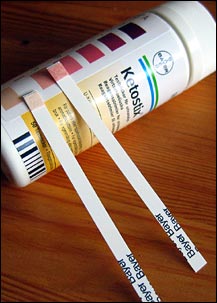
Anyways, I am a nerd and was curious about the ketone strips I pee on. Last week I was actually procrastinating by reading the ketostix box and trying to figure out how the reaction worked (no success) instead of studying the actual material. Yeah, that's how ridiculously distractable and unfocused I am - procrastinating by reading the box of my diabetes supplies, haha. That's why I had to cram for this exam.

I was checking for ketones because I'm still having weird blood sugar/insulin absorbtion issues, and I was having some unexpected highs and wanted to make sure my pump was working enough that I wouldn't be sick or wake up high and groggy the morning of my exam.


*non-pancreatically challenged folks' glossary: I and other type 1 diabetics might check our pee for ketones when we have unexplainable or multiple high blood sugars, think we might not be getting enough insulin, or are sick. Having ketones is different than just having regular high blood sugar (in fact, you can have ketones without high blood sugar), they are a sign of things not working right in the body and can be part of a dangerous cascade/imbalance if they are at high levels. It requires different and more careful management than just regular blood sugar issues. (Nerds: they are the byproduct of the body's metabolism when it switches over from it's normal fuel of sugar to breaking down fatty acids. The acidity in your blood can get dangerous.)

Saturday, October 20, 2007

follow-up on my fat runner soapbox

I got a response to my letter to the guy who wrote the stupid column about fat marathon runners = unprepared marathon runners:

When you note that you limit yourself to shorter races, you underline my point. You have wisely decided that the marathon is a challenge that requires intense preparation and may at this point be too much for you.

Many years ago, I trained my butt off to run a marathon: 12 weeks at 60 miles per week average, with some 7-day stretches over 100 miles. That is how I viewed the challenge of the event - something to be respected and taken very seriously.

The result? A 3:33 marathon for someone who had been 40 pounds overweight - 12 years earlier. I got myself in shape well before I tackled 26.2 miles. The training was a diet by itself.

For a variety of reasons, I never was able to put in that training time again. That is why my marathon career ended at 1.

Thanks for writing / PH
What irritates me the most about this most is the patronizing and wrong assumption that I have "wisely decided" a marathon is too much for me at this point, presumably related to my fatness.
As if:
a) He knew why i wasn't running a marathon. He doesn't - my reasons include being busy with school/work, diabetes struggles right now (which aren't caused by my fatness, thankyouverymuch), and not really wanting to. My knee pain is about #4 or 5 on that list, and if I lost weight I may or may not still have it.
b) I must be on this path (or at least be trying to be on it) of fat to skinny - I'm not.
c) The destination of the fat to skinny path is a marathon, you can't just do one while you're fat.

Also note his use of "in shape" to not only mean in shape, but also skinny as if they mean the same thing (my whole beef with his original column).

Tuesday, August 14, 2007

The Fantasy

Wow, that really sucks, but it's gonna be OK, and you're already good at _____ and ______, so that will help a lot.

Man, I'm so sorry. I wish you didn't have it. But we are going to be there for each other so much for support.

It's ok, I know it's hard. You need to be self-sufficient, but if you've had enough for tonight and you want me to, I can just give it to you, and then you can do your own shot tomorrow.

It's The Fantasy. The fantasy that I sometimes catch myself playing through in my head, that a close friend or family member will get diagnosed with diabetes too. I think the fantasy is always about type 1 and not type 2, which is interesting for a few reasons including how I identify with type 1 (and mark that difference), and the fact that it is WAY less likely (especially since most of the people close to me are adults or close to it).

I think I don't even stop and realize that I'm fantasizing, that I myself am creating this scene, until I've already manufactured a whole scenario and am running lines in my head between me and whoever my brain has chosen that time.

I don't actually want it to happen. Well, clearly part of me does, but when I weigh everything out, I definitely don't wish it would happen. I hope that it won't happen when I stop and think hard about the actual consequences.

So what is it about? I think fantasies in general are interesting. They are what the mind creates drawing from experiences and desires and all kinds of social norms and ideas and categories. And I think often they manifest themselves in a way that disavows, or tries to deny, some of the desire that is behind them. I notice sometimes that I am pondering a situation thinking about the situation or dialogue and what it means, and how I'd respond, as if it was something that actually happened or might happen. As if the people I'm thinking about had themselves done or said the things, and they could be responsible for them, when the actions or words are actually my creation. It can be really hard to figure that out and own that. Because it can be hard to even realize they are mine when the words came from the other persons' mouth in that fantasy, but also because it can be painful or make me look bad to have those thoughts actually be mine.

A class I took last year helped me think about things in this way and recognize how those fantasies work, especially pertaining to race stuff. I notice myself and other people, especially in the media, articulating racial situations and characters that are actually fantasies, creations, caricatures, reflections of our own thoughts, fears, desires, and sometimes even our own selves. It's really crazy but I think important to realize what I'm doing when I have those kinds of thoughts that are fantasies.

So back to this one... what does the diabetes fantasy mean?

Part of it I'm sure is that I want some company. I want someone to understand, to share some of my experiences. I actually have found a lot of company here online over the past year (diabetes blogs, facebook groups, tu diabetes, listserves), which does help me feel connected and supported a lot more than I ever expected from internet sources. But it's still a different fantasy about one of the people close to me, that are already in my life and share my experiences, to share this too, and maybe understand better.

On a deeper and kind of scarier, maybe uglier, level, I think I want to be able to comfort someone. Is this about comforting because that would validate me to be able to help make things better for someone else? Or because I want this kind of comfort from someone else? I don't think much about wanting or needing this intense kind of comforting from someone but maybe I do want it in some ways.

In a similar way, I want to be able to help someone by sharing my knowledge with them. I have all this intricate knowledge about blood sugar and food and insulin and exercise that is helpful to me, but somewhat random to most other non-diabetics. I want a chance for this knowledge to be useful. So that I could help someone else but also to validate myself. Interesting because I'm not sure how much I'd want this kind of "help" from someone else, but that's after years of building up knowledge. I guess I have absorbed a lot from other people over the years, although before I was part of this online community most didn't come from other diabetics. But that's also why my fantasy is about someone being newly diagnosed, and not someone else just having diabetes (remember this is created - it's a fantasy - so anything could happen, even though it's easier to imagine the newly diagnosed scenario because technically that is possible right now).

I think some of it is more superficial too. Just general speculation, playing around with the idea, since diabetes stuff is something that's so much a part of me and what I think about on a day to day basis, that I just think about and am curious about how it would play out with someone else.

I was worrying about how vulnerable I may have made myself by being so brutally honest in this post, and was encouraged to post it by what Amanda wrote over at BallastExistenz about there being no dumb questions, and reasons for writing difficult posts. Partly it's what she said, that other people may be thinking this and it may be helpful for them, or spark dialogue between us, if I post this. But others don't have to be thinking similar things to make it ok for me to post this.

It's more about the people I know that I worry than those that I don't - sometimes I wish I could have the opposite of a friends-only lock on an entry. A non-friends-only lock. I've wanted this on other things I've thought about writing. So that only people that don't actually know me could read it. So that I could say whatever I was thinking and not self-censor myself before it even comes out since I am thinking about my audience and what they might think. So that I don't have to worry about offending or hurting anyone, that I wouldn't have to worry about something seeming like a passive aggressive attack when I really just needed to say it, and wasn't directing it at anyone (whether it did or didn't actually have to do with them).

Sunday, August 12, 2007

The Avandia Cookies

So I looked at the label on my sugar-free cookies and was not happy to see that they're chock full of trans fats (the kind that are bad for your heart):


C'mon guys! If they can get the trans fats out of the glowing-neon-with-delicious-fake-cheezy-goodness Nacho Cheesier Doritos, they should be able to take them out of my sugar-free chocolate chip pecan cookies.

I'm calling them the Avandia cookies because they're good for the blood sugar, bad for the heart. Like the popular diabetes drug that has recently had attention called to it, they are maybe not so good for most diabetics if you look at the bigger picture because they may raise your risk of heart disease, which is the leading complication/cause of death among diabetics. And these cookies were clearly targeted at the diabetic market rather than low-carb dieters. You can tell by the package; dull and old-school rather than sexy and plastered with "LO CARB!" exclamations.

They sure were tasty though.

Thursday, June 28, 2007

Not exactly, Dr....

Today my doctor called me back and was off in her ideas and suggestions to me, and mostly the timing of them, in a way that was kind of hilarious to me. She was just so out of context.

Basically, a few months ago, I was having problems with insulin absorption from my pump sites, resulting in high and up and down blood sugars, occasionally ketones, and therefore feeling shitty, physically and mentally/emotionally. Went on shots for a few months, which was better but made exercise, especially longer workouts, really hard to manage. Three weeks ago I started back on the pump, and overall things have been going well, but I've been having a lot of lows. These are mostly exercise related, since it's been easier to do a lot more of that with my pump back than it was for me on shots. Also, it is summer and I tuned up my bike.

But anyways, I said something about being able to exericse more, and she was like, yeah, it must be easier and you must feel much better without all that ketosis! Ha ha ha. That was um, about 16 weeks ago that my pump wasn't working and I had ketones. A lot has happened since then. If I had ketones for all that time, she definitely would've heard from me again. Slash I would be REALLY frustrated and sick and ended up on sick leave from my job or something. What I meant was because of the pump vs. shots in the last 3 weeks making it easier to exercise, not the no longer having ketones thing from bad pump sites months ago.

I don't fault her for that; it wasn't like she was being negligent to my health. And some of the things she said may be relevant if problems come back (hopefully they won't). I hadn't asked for continued help because I was doing better, and she was actually calling me back about something else, a basic logistical question about getting my next A1C (that's a routine diabetic blood test, for you folks that have internal automatic pancreases and are challenged on this lingo).

My diabetes is mine; it's a little weird to negotiate intrusions on that. Usually I think I am right to react in a way that let's people know this is my business and my body when they are intruding in a way that I find unhelpful or annoying. This doesn't mean it's off limits and noone can talk about it except me (in fact, I like it when friends or acquaintances are comfortable talking about it), just that I get to make the decisions, and be the expert. It's my body, and I have a lot of experience dealing with it, and generally know what I'm doing (or if I don't, probably you don't have the magic-bullet solution either).

With my doctor (and I mean my doctor that manages my diabetes, not all of the assorted people related to me that are doctors and bubbling with ideas about parts of my diabetes that they sometimes have no idea about), I definitely see the need for this shift, letting her in, it just is funny to figure out sometimes. Back when I was having the absorption problems, I felt like I was a little kid regressing and begging for her to hold my hand when I read her all my numbers and got help on dosing - it felt kind of wrong, even though it was probably necessary.

She has knowledge and skills that are different and help me, whether it is her training/experience or just another perspective from someone else familiar with the issues. She recognizes my expertise on my own body, because she is a good doctor and respects me*, but also because she is forced to because I just know so much more than her about what's going on. She needs my knowledge and assessments and details to even think about understanding anything or making treatment recommendations. I think this is one thing that might differentiate the relationship between type 1's and their healthcare providers (and maybe other folks with chronic issues and their providers?) and the way a lot of other people's relationships are with their healthcare providers. It is so constant and intensive and hundreds of decisions are necessary day-to-day, when the doctor isn't around, that the person with type 1 has to be recognized as an expert. Of course, I think healthcare would work a lot better for most people if providers ALWAYS recognized (and respected) the patient as the expert on their own body. And probably their are a lot of doctors that are bad at this even with type 1's, and don't do this even when it is painfully obvious that it's the case.

*hopefully this is how she treats all her patients, and this respect isn't just from me being well-read on my issues and considering nursing or medicine as a profession

EDIT: Another diabetic blogger just posted a news story that's a lil' empirical evidence for what I just wrote about, that obviously the person with diabetes is the expert over the doctor. Interestingly, this study on insulin dosing was with type 2 diabetics, who usually (not always) have less intensive medication and testing regimes than type 1's.

Thursday, June 21, 2007

fuck you, bush

Bush vetoed the embryonic stem cell funding bill for the second time.

I'm not that into exclusively cure-focused diabetes research as much stem cell research is. And I also am not so into the recent stem cell research findings that came out a few months ago in which they were able to reverse early stages of Type 1 with intensive chemo to kill the immune system and then a stem cell transplant (more on these things soon, I have posts on them that I just haven't finished). However, I think this research should happen, and especially for issues besides diabetes that are less treatable. But mostly, the justification he has just really bothers me.

This 'destroying human life' bullshit that he says pisses me off. It's like, what about my life? You're choosing balls of cells over me? If you want to talk about ethics, let's bring this into focus. I am here, a person, living right now, as are millions of other diabetics and people with other conditions that could benefit from stem cell research. If you care about preserving human life at any ridiculous cost, why not work on those cases that are already a real live life? Instead of those potential little things sitting in freezers not going anywhere. What, it's not worth 'saving' damaged goods like us?
EDIT: As 'Artificially Sweetened' reminded me, the bullshit here is especially obvious when you remember he didn't give a shit about the value of each and every human life, of US troops or Iraqi civilians, when we went to Iraq and bombed everything.

By the way, these vetoes were 2 out of only 3 that Bush has done his whole time in office. Boy, he must really love those frozen balls of cells that are just sitting in freezers (I'm probably going to get on the anti-abortion anti-embryonic stem cell research hit list for saying that, oops) , good thing he's SAVING all of them. He's saving their little lives. What a savior, don't you just love him?

Thursday, May 31, 2007

low creativity?

p.s. : Sometimes I think I have more lucid, creative thoughts when I'm low. Like I think of all these random interesting ideas, or even can synthesize thoughts better than usual. When I was walking home and low (sometime between the 72 and the 55), I had a few ideas about some stuff I've been stewing over and trying to write about all week. This is when I'm just starting to get low I guess, before I get too cranky, although sometimes I thin it happens even when other forms of coordination/strength are starting to go. Anyone else noticed something like this?

Maybe it's like being high or something, an altered brain state gives you a new creative perspective? Lowered inhibitions to think more freely (especially about stuff I'm trying to write and therefore may have anxiety around)? Or maybe it's just the adrenaline rush.

72

Tested my blood sugar before leaving work tonight: 72. That should be a number I'm really happy about, on the low range of my goal, perfect at a time when I probably will eat a meal soon-ish. It used to be. However, with all the yo-yos I've been having, especially around exercise, and without my pump (I am on shots for a few months to give my pump sites a break; scar tissue was causing really crazy/bad absorption), 72 makes me not happy.

On the pump, I would've turned my basal rate down or off for a while, and probably been fine. Maybe had to eat a little bit of something, maybe not. But on shots...

72 usually means that if I don't do anything, I will get low by the time I'm home or during the trip home, which usually includes almost a mile of walking to and from trains. If I had planned on biking all the way home, forget it. I'd have to get on the train unless I felt like eating a ton of food and risking getting low in a place that I don't feel so comfortable stopping by myself and want all of my strength (mental and physical) and biking abilities that make me safer.

So tonight I ate a fruit leather (bougie hippie natural version of a fruit-roll up) before I started walking even though I didn't really want to. I prefer not spend my food money, appetite, and calories (yeah, I wanted to leave that last one out of this story but I'd be lying) on eating dried fruit or gatorade instead of yummier, healthier, cheaper, more fun real food. That I could eat when I actually am wanting to eat instead of having to.

And I still was low (55) when I got home.

That's not a terrible low, but not where I want to be. Enough to make the walk home less fun, and make me cranky enough that I might pick a fight with family or friends trying to interact with me while I'm low. Also, lows, even really mild ones, don't facilitate good, conscious eating. It's more like grabbing whatever I see and inhaling it standing up instead of enjoying a thought out, balanced meal that I enjoy. And feeling low certainly isn't going to have me actually cooking anything for dinner. Besides being frustrating in and of itself, this is also frustrating and ironic because part of my up and down roller coaster blood sugar issues are because of this very thing - not planning or counting (carbs) well enough, not scheduling sit-down meals on a consistent schedule enough.

I've pinned the problem with not having a pump and exercise or scheduling problems down to 2 major issues, at least for me:
1) Not being able to have different basal rates at different times of the day (eg lower for exercise, higher for sitting around at work). With shots (lantus), you just have one basal for all day and all night.
2) Not being able to make decisions about my insulin 0-120 minutes ahead of time, as you can with the pump. With shots it has to be the meal before and/or the lantus shot up to 24 hours earlier.

How do people not on pumps do exericse? Or... life? I don't get it. I guess the privilege of having the pump for 6 years has really pampered me. Maybe my blood sugars are more wacky and variable than other people's, and I'm sure my erratic schedule doesn't help with that. But really!? How do you do exercise unless you're willing to eat a lot of fast-acting sugar constantly? Or your exercise is a planned trip to the gym at the same time every day that isn't too long of a workout and then you make sure to not move for the rest of the day? That's not really the type of exercise I like or how my life is and I want it to be. I need and love my little walking or biking trips interspersed throughout my day to keep me happy, sane, focused, and to have the time to fit in a lot of exercise because it is part of my commute. And to not have a car, which I don't want (and probably couldn't afford now anyways).

I'm off to attempt a run, hopefully without another low or a high enough to stop me after rebounding from that 55 (and, of course, overtreating it).

For non-insulin-pumpers that need help with vocab: a glossary

Diabetes blogging community and categories

I've been thinking about splitting a separate diabetes blog off of this one. I hadn't planned on posting lots of random daily stories, frustrations (aka my blood sugars are still crazy yo-yoing with exercise, and also drinking in a way that they didn't as much with the pump, and I MISS MY PUMP!!), and successes, more on thoughts or rants about issues that come up from those stories. But it's appealing after finding this huge diabetes blog community that is exciting for me to read, connect with and be a part of.

My pseudo-academic postings and non-diabetes-related rants might be boring and push away people looking for diabetes community. And non-diabetic people here for the other stuff might not be interested in the minutia of my daily issues, and won't get those thrills of connection and intimate familiarity with stupid mundane things that I know I get when reading other diabetes blogs. Maybe I would be able to build more of an interactive community, get more comments, if I split them.

But, let's face it. I can't even keep up with one blog, let alone two. And I don't really like the idea of splitting myself up into separate categories like that anyways.


Edit: I've added more links to other blogs I read sometimes, including a separate list of diabetes ones.

Saturday, April 14, 2007

Drug prohibition is stupid aka GIVE ME MY SYRINGES, JERK!


Today I tried to buy 10 syringes without a prescription and was denied. I had left a box at work in a building locked over the weekend, and I needed more. I knew from working in HIV prevention/surveillance about the IL law that allows people over 18 to buy (and possess) up to 20 syringes without a prescription. Although it is limited in it's ability to increase access to clean syringes (cost, needing an ID to prove age for undocumented immigrants, trans people, young people, and poor people, and the issue of pharmacies actually complying), I think it's a great step in the right direction because it supports harm reduction and drug decriminalization.

Moralizing is stupid and an obstacle to accessing dignified healthcare and other services. The U.S. war on drugs is racist, harmful domestically and in other countries (like Colombia), and ineffective. Yes, non-prescribed injectable drugs can be harmful, but dirty needles are harmful too, and forcing someone to use them doesn't help anything! Several studies have shown that pharmacy sales of syringes without a prescription did not increase illegal drug use, and decreased high-risk behaviors for HIV. Sharing syringes is a major source of HIV and Hepatitis C infection:
  • In the U.S., about 50% of all new HIV cases can be traced back to injection drug use (in people that use, their partners, or their children).
  • Sharing syringes is the leading source of Hepatitis C infection.
  • In Illinois, 70% of AIDS cases among women and almost all pediatric AIDS cases are associated with sharing syringes (including sharing of syringes by the mother of the child who is then exposed at birth).
I think that, among many other things, a fundamental disrespect of or apathy towards the lives and well-being of people affected by these issues is at the root of policies refusing to provide access to clean syringes. In addition to moralizing anti-drug sentiments, racism, classism, and sexism play into this. The Chicago Department of Public Health reports that the 2005 HIV diagnosis rate in black females was more than 15 times that of white females.

Despite citing the law and threatening to report her to the AIDS Foundation of Chicago syringe access project, the pharmacist still refused to sell me the syringes. She acknowledged that the law exists but said, "it's at the discretion of the pharmacist." Even when I appealed to the fact that I am diabetic and needed them for insulin, offering to show her my medic alert bracelet and blood test meter, she refused. I think that people that need clean syringes to prevent HIV/Hepatitis C infection when they use syringes for other purposes not sanctioned by laws and/or medicine (illegal drugs, unprescribed hormones) "deserve" them just as much, but my diabetes is seen as more deserving by many people so I tried that appeal.

It was pretty incredible to have someone look at me and say, no, I am going to deny you access to the supplies that you NEED to stay alive and healthy. And have them have the power to make that decision. I guess a lot of people face this kind of cruel denial on a routine basis, from lacking funds or other issues with our fucked up health care system.

(I did get the syringes from another pharmacy without a problem).

Thanks to the diabetes art pool for the image.

Thursday, March 15, 2007

discomfort with anger, civility, and diabetes

I have been meaning to write something about diabetes and class. And then I was going to write something just about diabetes and things I've been thinking about my experiences since I've had to life more within them (and more constantly) lately with the problems I've been having. But then I got lazy. And then I got into an argument with my dad, so this is what I wrote instead. There's a lot of other things I want to bring out eventually, but too tired now.
PS I don't hate my dad, and this isn't meant to be a personal attack. I'm just frustrated and it illustrates really well what I think happens in a lot of situations.

my dad is so into civility and doesn't like anger. so frustrating to communicate with. since he can't deal with anger, frustration, or conflict, he can only discuss things on his terms or not at all. I asked him (i worked so so hard to be nice and "rational" and articulate cuz i knew this would be an issue) to stop 2nd-guessing me when I say i know what the problem is and my pump isn't working after another incidence of him continuing to second and third-guess me even after i spend a lot of time/energy laying everything out. and i said my anger was healthy and necessary and part of life.

now he says he won't discuss my diabetes with me anymore if that's what i want. it's not, i just want to discuss it without being constantly 2nd guessed. or if i "all i want do to is express my anger" (cuz clearly that's incompatible with conversation or intelligent exchange, of course). i was trying to stay understanding and communicate well with him, but it didn't work. he legitimately has some emotional issues with avoiding conflict i think, but still not fair and a cop-out. he got just what he wanted - this conversation about my diabetes doesn't occur unless it is on his terms, unchallenged. and it's so about upholding a fucked up civility - keeping me from getting angry or us from getting in a conflict under the guise of trying to avoid somethign that upsets me (which is there no matter what, by the way, and it's his reaction, not my diabetes itself that i was upset about in that moment), rather than actually addressing my concerns and engaging with me.