Showing posts with label knowledge. Show all posts

Monday, October 29, 2007

Newsflash!

Did you know that breastfeeding could abolish all diabetes? No, you didn't? That's because it can't!!

Last week, a nurse (possibly a nurse practitioner) said at a health care activism meeting, well, if everyone breastfed, there would be no diabetes.

Um... I say, I am diabetic and I was definitely breastfed for a long time.

Instead of owning up to the stupidity and insensitivity of her comment, or at least backing off a little, this woman says, "Really?!! Wow, you must be the outlier, the one exception! It's an inflammatory process!"

Hell no. This woman did not only just talk about me and my mother, but then she tried to defend her statement and act all surprised.

I thought about not even telling my mom (a nurse practitioner) about it because even though we both know it's bullshit, I don't want her to even think for a second about blaming herself or that I might blame her. But, I decided to, and she articulated another thing about it that bothered me. She said, "Doesn't sound like politics to me, sounds like blaming the victim." Yes, the blaming the victim thing. Stupid and fucked up. But I think it was politics, or "blaming the victim" masquerading as a political statement/rebellion, which bothers me even more. And blaming mothers is a recurring theme in our culture.
EDIT: As I was writing this post, I found this great discussion going over on Scott's blog about diabetes, breastfeeding, and blame/guilt.

I am actually all about breastfeeding for mothers that are able to, but this comment was just ridiculous for a couple reasons. Even though I do think traditional medicine can be harmful sometimes and natural methods have a lot to offer, the "natural medicine" pusher people piss me off a lot because they take it to an extreme that is able-ist and/or just dumb. Also, not all mothers are able to breastfeed for various health and other reasons.

In general, people that think they have a cure-all "natural" solution for my diabetes, or whatever else, are pretty arrogant to think that they have the fix to something that I devote endless time and energy to on a daily basis. If it was that simple and complete a solution, don't you think I would have found it? Or am I just stupid for muddling through with my traditional medicine? Do you want to see what happens to my body for even 4 hours without any insulin?

Now, that nurse wasn't suggesting she had a cure for me now. This is just an example of where that kind of statment takes you. It's a way of invalidating my very real experience. That's the problem with universalizing especially when you havent had that experience (and especially when you're working out of this ableist framework).

Also, even if it really was true that breastfeeding can prevent all diabetes, that's a pretty serious, loaded thing to say in such a cavalier way to someone you met 15 minutes ago.

I need to learn to write shorter posts. If you're getting bored, you can consider yourself done here! More ramblings of mine follow...


There are studies that show breastfeeding does significantly reduce the chances of a kid developing type 1 diabetes. And inadequate nutrition as a fetus, infant, or child can be linked to higher risks for stuff like type 2 diabetes and other health issues as an adult (one reason why I think we need to look at environmental stresses like poverty, etc. before anyone chalks up racial health disparities to genetics, which can often end up being just a new sophisticated incarnation of scientific racism). But for her to talk about this one single cause is really inaccurate. And her justification that it's an "inflammatory process" doesn't help her case, because there are so many different triggers that contribute to inflammation.

Also - speaking of ableism - this nurse also made a bunch of comments about well, if something ever happens to me, that's it. pull the plug. She was trying to make a point about the excess money we spend in the U.S. on heroic measures like ventilators at the end of life. I actually agreed with some of what she was saying, that we need to reexamine what life is and how we're spending our healthcare dollars, and if we really want, from a financial
and quality of life standpoint, to be living hooked up to tons of stuff instead of letting ourselves die peacefully when life is ending. But I don't think needing outside assistance from other people, machines, or drugs are the definition of when life is worth living or not, and her statements went too far into ableism and almost even eugenics.

Do you really think life with illness isn't worth living? And do you want to say that to me and the woman sitting next to me that looks like she might have cancer? Besides being a messed up way of thinking, MOST people live with illness or disability in some form at some point (especially people that are not upper-class white people like she and I). And I think to not recognize that is both inaccurate and ableist in that it reinforces this idea that healthy and perfect (and requiring no outside help from other people/medicines/therapies/etc) is the "normal" state for everyone, and a fall from that is remarkable or abnormal.

Wednesday, October 24, 2007

Theory and Practice: Ketones

I couldn't help but be hit on the head with the irony of checking for ketones* while I crammed for my chemistry test on guess what? Ketones (and other carbonyl compounds). My professor likes to emphasize that we should not just memorize the material but understand it and know how to apply it. Unfortunately, he was talking about applying it in the form of writing reactions down on paper, and my excellent ability to pee on a strip and correctly read and interpret that data didn't earn me any extra points today. And I sure could've used them.

Since there were only a couple of us taking the exam in the office, I was totally tempted to make some joke or mention to the professor about the ketones. Some way to get a little validation for being funny/smart/special from the (hot) professor as I failed his exam. But I couldn't figure out how to do it without mentioning my urine, and well, that just seemed to defeat the purpose. Not so attractive, baddecisionmaker, not so attractive.

I took the exam in the professor's office before class because that was my accommodation through the disability resource center (since I might need to leave to pee, or need extra time in case of a low or high). It was the first time I've officially registered my diabetes; at the college I graduated from it was more relaxed; classes were smaller, and I relied on just talking to professors. I have had more problems lately, and also have started thinking about my diabetes and ability/disability a little differently in the last 5 years since I started college. I got more time than I would've even though my blood sugar wasn't too crazy, but this accommodation was actually not great for me because I took it at 10am instead of noon, and I do not function well in the morning (and could've really used the extra 2 hours to study). Also, the professor was having office hours at the same time so it was not quiet. Maybe he hadn't thought about this because the other kid getting accommodations there with me was deaf. I was jealous.

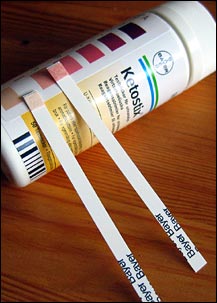
Anyways, I am a nerd and was curious about the ketone strips I pee on. Last week I was actually procrastinating by reading the ketostix box and trying to figure out how the reaction worked (no success) instead of studying the actual material. Yeah, that's how ridiculously distractable and unfocused I am - procrastinating by reading the box of my diabetes supplies, haha. That's why I had to cram for this exam.

I was checking for ketones because I'm still having weird blood sugar/insulin absorbtion issues, and I was having some unexpected highs and wanted to make sure my pump was working enough that I wouldn't be sick or wake up high and groggy the morning of my exam.


*non-pancreatically challenged folks' glossary: I and other type 1 diabetics might check our pee for ketones when we have unexplainable or multiple high blood sugars, think we might not be getting enough insulin, or are sick. Having ketones is different than just having regular high blood sugar (in fact, you can have ketones without high blood sugar), they are a sign of things not working right in the body and can be part of a dangerous cascade/imbalance if they are at high levels. It requires different and more careful management than just regular blood sugar issues. (Nerds: they are the byproduct of the body's metabolism when it switches over from it's normal fuel of sugar to breaking down fatty acids. The acidity in your blood can get dangerous.)

Thursday, October 11, 2007

gettin' up on my fat runner soapbox

I had to get up on my fat runner soapbox again today. It's interesting because I actually feel like I've been passing as "not fat" a lot more this year, between getting a little thinner and moving from a residential college campus full of rich young northeastern disproportionately white people back to Chicago and the work world that has a lot more body size diversity (and frankly, people are just fatter on average) which I think has something to do with the region, class, and age make-up of people I am around. However, I think I still definitely count as fat among runners. Heck, I'm slower with the same or more effort sometimes (I could probably leave those skinny people in the dust if they had another 50 pounds strapped on them), and I'm in the largest of 4 Clydesdale (bigger runners circuit, which is an awesome idea) categories for females.

I wanted to re-write this to make it more in my own voice and ass-kicking rather than what I tailored so that this columnist might be able to hear me and I might have a chance of getting printed. But I really need to get to studying or sleeping, and I think that kind of perfectionism prevents me from posting as much as I'd like to (ahem, see the last 2 months), especially when I'm busy. So here goes:

Regarding Phillip Hersh's comments (October 9, "A Saner, Safer Race) I agree with your point that a marathon is strenuous and runners should be well-prepared (although this does not absolve race organizers of the mismanagement that resulted in stations running out of water and Gatorade on a dangerously hot day). However, your comments about who "looks" like they can run a marathon were inaccurate and disrespectful. You cannot see by looking at someone how many training runs they have done.

I have never done a marathon, but I have done many shorter races, and despite training adequately and eating healthy food, I was still fat. I'm only running a few miles a week now, but I bike 50-60 miles a week, and yep, I'm still weighing in with a fat BMI of 29. The only way for me to become a skinny person that "looks" like a runner would be to go on a strict diet for years, and I actually enjoy my body and don't have enough self-loathing to want to do that. I'd rather put my energy into exercising, enjoying my life and taking care of my health.
EDIT FOR BLOG ENTRY: Screw that, I'd literally have to get myself a full-fledged eating disorder (for both physical ability for that to be possible and the attitude I'd have to have to dislike my body enough/be driven enough to have that kind of discipline) to be able to do that! I'm never going to "look" like a runner with that definition. Nor do I want to.


There are lots of us fat runners out there that "deserve" to be racing. I'm sure some of the fat runners trained adequately and were well-prepared at the starting line last Sunday, and some weren't. Just like the skinny people - some were prepared, and some of them weren't. Being skinny does not mean you are in shape to run a marathon. Being bigger does mean that you probably won't be able to run as fast as skinny people, but it absolutely does not automatically mean you are unprepared and should not be running. The Clydesdale circuits (the Chicago Area Runners' Association includes the Chicago Marathon) for bigger runners recognize this, and provide a forum for bigger runners to compete. See http://cararuns.org/cara_info/clydesdales.html

Additionally, if being heavier puts a runner at risk for anything, it is joint problems, not dehydration. Anyone who pushes their body too hard on an 88-degree day puts their health at risk.

Sincereley,
me


Thursday, June 28, 2007

Not exactly, Dr....

Today my doctor called me back and was off in her ideas and suggestions to me, and mostly the timing of them, in a way that was kind of hilarious to me. She was just so out of context.

Basically, a few months ago, I was having problems with insulin absorption from my pump sites, resulting in high and up and down blood sugars, occasionally ketones, and therefore feeling shitty, physically and mentally/emotionally. Went on shots for a few months, which was better but made exercise, especially longer workouts, really hard to manage. Three weeks ago I started back on the pump, and overall things have been going well, but I've been having a lot of lows. These are mostly exercise related, since it's been easier to do a lot more of that with my pump back than it was for me on shots. Also, it is summer and I tuned up my bike.

But anyways, I said something about being able to exericse more, and she was like, yeah, it must be easier and you must feel much better without all that ketosis! Ha ha ha. That was um, about 16 weeks ago that my pump wasn't working and I had ketones. A lot has happened since then. If I had ketones for all that time, she definitely would've heard from me again. Slash I would be REALLY frustrated and sick and ended up on sick leave from my job or something. What I meant was because of the pump vs. shots in the last 3 weeks making it easier to exercise, not the no longer having ketones thing from bad pump sites months ago.

I don't fault her for that; it wasn't like she was being negligent to my health. And some of the things she said may be relevant if problems come back (hopefully they won't). I hadn't asked for continued help because I was doing better, and she was actually calling me back about something else, a basic logistical question about getting my next A1C (that's a routine diabetic blood test, for you folks that have internal automatic pancreases and are challenged on this lingo).

My diabetes is mine; it's a little weird to negotiate intrusions on that. Usually I think I am right to react in a way that let's people know this is my business and my body when they are intruding in a way that I find unhelpful or annoying. This doesn't mean it's off limits and noone can talk about it except me (in fact, I like it when friends or acquaintances are comfortable talking about it), just that I get to make the decisions, and be the expert. It's my body, and I have a lot of experience dealing with it, and generally know what I'm doing (or if I don't, probably you don't have the magic-bullet solution either).

With my doctor (and I mean my doctor that manages my diabetes, not all of the assorted people related to me that are doctors and bubbling with ideas about parts of my diabetes that they sometimes have no idea about), I definitely see the need for this shift, letting her in, it just is funny to figure out sometimes. Back when I was having the absorption problems, I felt like I was a little kid regressing and begging for her to hold my hand when I read her all my numbers and got help on dosing - it felt kind of wrong, even though it was probably necessary.

She has knowledge and skills that are different and help me, whether it is her training/experience or just another perspective from someone else familiar with the issues. She recognizes my expertise on my own body, because she is a good doctor and respects me*, but also because she is forced to because I just know so much more than her about what's going on. She needs my knowledge and assessments and details to even think about understanding anything or making treatment recommendations. I think this is one thing that might differentiate the relationship between type 1's and their healthcare providers (and maybe other folks with chronic issues and their providers?) and the way a lot of other people's relationships are with their healthcare providers. It is so constant and intensive and hundreds of decisions are necessary day-to-day, when the doctor isn't around, that the person with type 1 has to be recognized as an expert. Of course, I think healthcare would work a lot better for most people if providers ALWAYS recognized (and respected) the patient as the expert on their own body. And probably their are a lot of doctors that are bad at this even with type 1's, and don't do this even when it is painfully obvious that it's the case.

*hopefully this is how she treats all her patients, and this respect isn't just from me being well-read on my issues and considering nursing or medicine as a profession

EDIT: Another diabetic blogger just posted a news story that's a lil' empirical evidence for what I just wrote about, that obviously the person with diabetes is the expert over the doctor. Interestingly, this study on insulin dosing was with type 2 diabetics, who usually (not always) have less intensive medication and testing regimes than type 1's.